668 vs 667: Which SIM Check Do You Need?
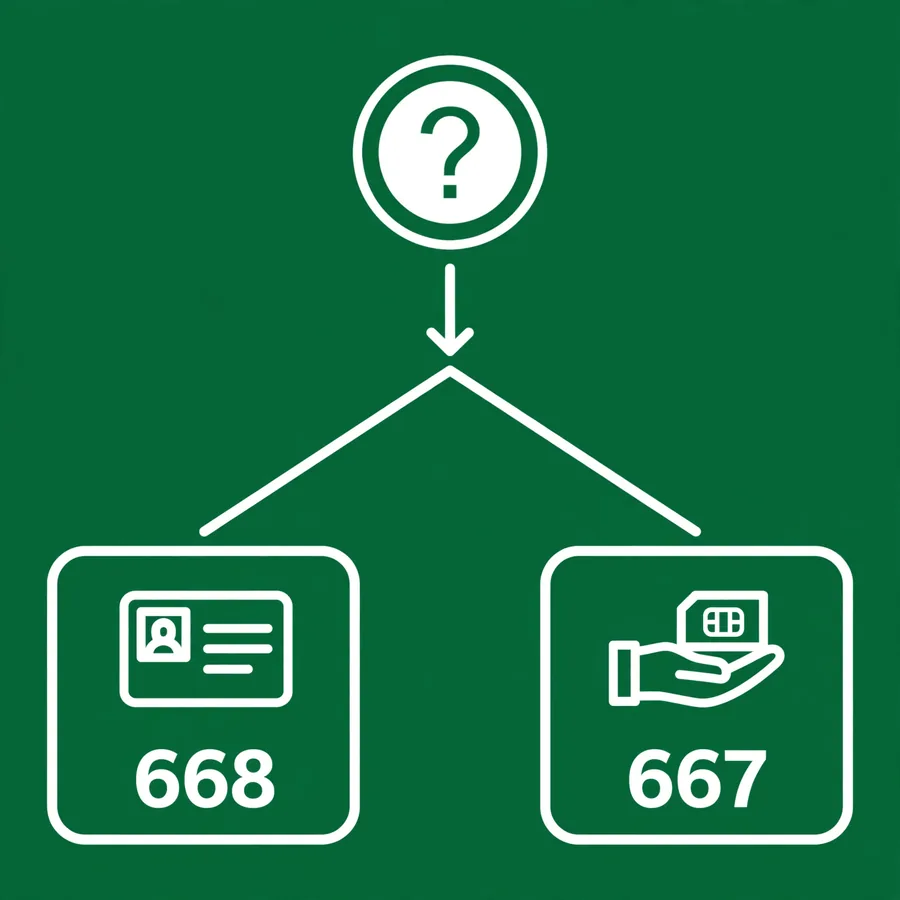
668 vs 667 is the most common confusion in Pakistani SIM checking, and the confusion is understandable: both are PTA SMS codes, both deal with SIM registration, and their digits are one apart. But they answer completely different questions. 668 asks: “how many SIMs are on my CNIC?” 667 asks: “is the SIM sitting in my phone registered to me?” They query different systems and cannot be used interchangeably. This guide is the decision: one table, one decision tree, five scenarios, and the mistakes to stop making.
For the step-by-step mechanics, jump to the dedicated guides: 668 SIM Check and 667 SIM Check. This page only decides which one you need.
Quick answer: 668 vs 667
- 668: send your 13-digit CNIC. Reply = SIM count per operator. Use it for a full identity audit.
- 667: send MNP. Reply = the sending SIM’s registration record. Use it to verify one specific SIM.
- 668 covers everything on your CNIC; 667 covers just the SIM in your hand.
- Raabty’s rule: use 668 every month to audit your CNIC; use 667 whenever a SIM changes hands.
668 vs 667 in One Table
| 668 | 667 | |
|---|---|---|
| Question it answers | How many SIMs are on my CNIC? | Is THIS SIM registered to me? |
| What you send | Your 13-digit CNIC | The word MNP |
| Send from | Any Pakistani SIM | The SIM you want to check (only that one) |
| Reply shows | Count of SIMs per operator | Registration record of the sending SIM (typically name + masked CNIC + activation date) |
| Reply never shows | Phone numbers or names | Other SIMs on your CNIC |
| Cost | About Rs 2 + tax (PTA: charges may apply) | Standard SMS rate, about Rs 1.50 to 2.50 |
| Speed | Seconds to a minute | Usually 5 to 10 seconds |
| Internet needed | No | No |
| From abroad | Needs a Pakistani SIM | Needs a Pakistani SIM (the SIM itself) |
| Free web version | Yes: cnic.sims.pk portal | No |
| Best for | Monthly CNIC audits, identity safety | Used SIMs, found SIMs, porting |
The Decision Tree: Which One Do You Need?
- “I want to know every SIM registered on my name” → 668 (or its free web twin, the cnic.sims.pk portal).
- “I just bought a phone/SIM and want to confirm it is really mine” → 667, from that SIM.
- “I found a SIM card and wonder whose it is” → 667 tells you if it is yours; if it is not, hand it in (see our disown guide for the related process).
- “I want to move my number to another network” → 667 is step 1 of porting.
- “Whose network is this number on?” → Neither: that is 76367 (see our by-number guide).
- “Who owns the number that keeps calling me?” → Neither code does that. Ever. Report it instead (NCCIA 1799).
5 Real-Life Scenarios
- Buying a used phone with a SIM inside. Before paying, insert your own money’s worth of caution: text MNP to 667 from that SIM. If the registration does not match the seller’s story, walk away.
- Your monthly identity audit. Text your CNIC to 668. Any count higher than the SIMs you own means a stranger is using your identity: disown it.
- You lost a SIM. 668 tells you the SIM still sits on your CNIC (so block it fast via your operator). 667 cannot help here: the lost SIM is not in your hand.
- Porting to a new network. Text MNP to 667, then visit the new operator’s franchise with your original CNIC within 10 days. The full process lives in our 667 guide.
- You are overseas. 668 and 667 both need a Pakistani SIM. The portal works from anywhere, free: use it for the CNIC audit.
4 Mix-Ups That Waste Your SMS
- Typing your CNIC to 667. 667 ignores whatever you type except MNP: it reads the sending SIM only. A CNIC in the body changes nothing.
- Typing MNP to 668. 668 expects a 13-digit CNIC. “MNP” is meaningless to it.
- Calling 667. Both codes are SMS-only. Dialing 667 does nothing at all.
- Adding dashes to your CNIC for 668. “35201-1234567-8” fails. Send all 13 digits with no dashes or spaces.

The Honest Cost Truth
Comparison pages contradict each other (one major site’s FAQ says 668 “costs Rs 2 plus tax” while its own cost section admits PTA publishes no price). Here is the documented history: 668 launched at Rs 2 (2009), went free (2011), then PTA moved to “charges apply” (2023) and, in its 31 December 2025 press release, “charges may apply”. Guides converge on about Rs 2 + tax for 668. For 667, operators publish no fixed fee either; expect the standard SMS rate, about Rs 1.50 to 2.50. Anyone advertising either code as “completely free” is guessing. The genuinely free check is the portal.
FAQs
What is the main difference between 667 and 668 Pakistan?
668 checks all SIMs across every network registered on a CNIC and returns per-operator counts. 667 checks the SIM physically in your phone and returns that SIM’s registration record (typically the registered name, a masked CNIC, and the activation date). They query different systems and cannot be used interchangeably.
Is 668 free in Pakistan?
No. PTA’s official wording is “charges may apply” (31 Dec 2025 press release), and guides converge on about Rs 2 + tax. The completely free alternative is the cnic.sims.pk portal, which answers the same question.
Is 667 free?
Not exactly. There is no PTA-published fixed fee; operators charge the standard SMS rate, typically Rs 1.50 to 2.50.
Do I need both 668 and cnic.sims.pk?
No. They answer the same question from the same registry: 668 by SMS, the portal on the web (free, and it works from abroad). Use whichever fits your situation.
Can I use 667 to check who owns a number I received a call from?
No. 667 only reads the SIM physically in your phone. You cannot type a stranger’s number into it. For the caller’s network, use 76367; for the caller’s identity, only the authorities can help (report harassment to NCCIA 1799).
Can I use 668 to check someone else’s SIMs?
No, and do not try. 668 reads whatever CNIC you type, but using another person’s CNIC without consent breaches PECA 2016 Section 16 (up to 3 years in prison and Rs 5 million fine). Only ever check your own CNIC.
668 ya 667: konsa kab use karun?
Apne CNIC par tamam SIMs ginnay ke liye 668 (CNIC bhejein). Haath me mojood ek SIM verify karne ke liye 667 (MNP bhejein). Rule yaad rakhein: 668 mahana audit ke liye, 667 jab SIM haath badle.
What happens if I send my CNIC to 667 or type MNP to 668?
Nothing useful. The formats are not interchangeable: 667 only responds to MNP (and reads the sending SIM), while 668 only responds to a 13-digit CNIC.
Can I call 667 instead of texting it?
No. 667 is SMS-only; calling it does nothing. The same applies to 668.
Which check should I use first?
Start with the question: SIM in your hand → 667. Full CNIC count → 668 or the portal. A number’s network → 76367. Choose the route by the information you need.
Conclusion
The 668 vs 667 choice is really a choice between two questions: “what is on my identity?” (668, or the free portal) and “is this one SIM mine?” (667). Pick by the question, not by the digits. For the full mechanics of each, see the 668 SIM Check guide and the 667 SIM Check guide.

One Comment