Here is the one thing that confuses everyone about 667: it never answers questions about a number you type in. A 667 sim check reads the registration of the one SIM physically sitting in your phone, the SIM you send the SMS from. That single rule explains everything 667 can and cannot do, and this guide covers all of it: the exact format, the reply, the charges, the port-out process it was built for, and the honest difference from 668.
Looking for every SIM on your CNIC instead? That is a different question with different tools: see our 668 SIM Check guide or the CNIC SIM Check portal guide.
Quick answer: 667 SIM check in 20 seconds
- Insert the SIM you want to check (667 reads the sending SIM only).
- Type MNP (no extra characters) and send it to 667.
- Read the reply: that SIM’s registration record.
- Works on all networks (Jazz, Zong, Telenor, Ufone, SCOM, ONIC).
- Charges: typically Rs 1.50 to 2.50 (standard SMS rate).
Text MNP to 667 in 20 Seconds
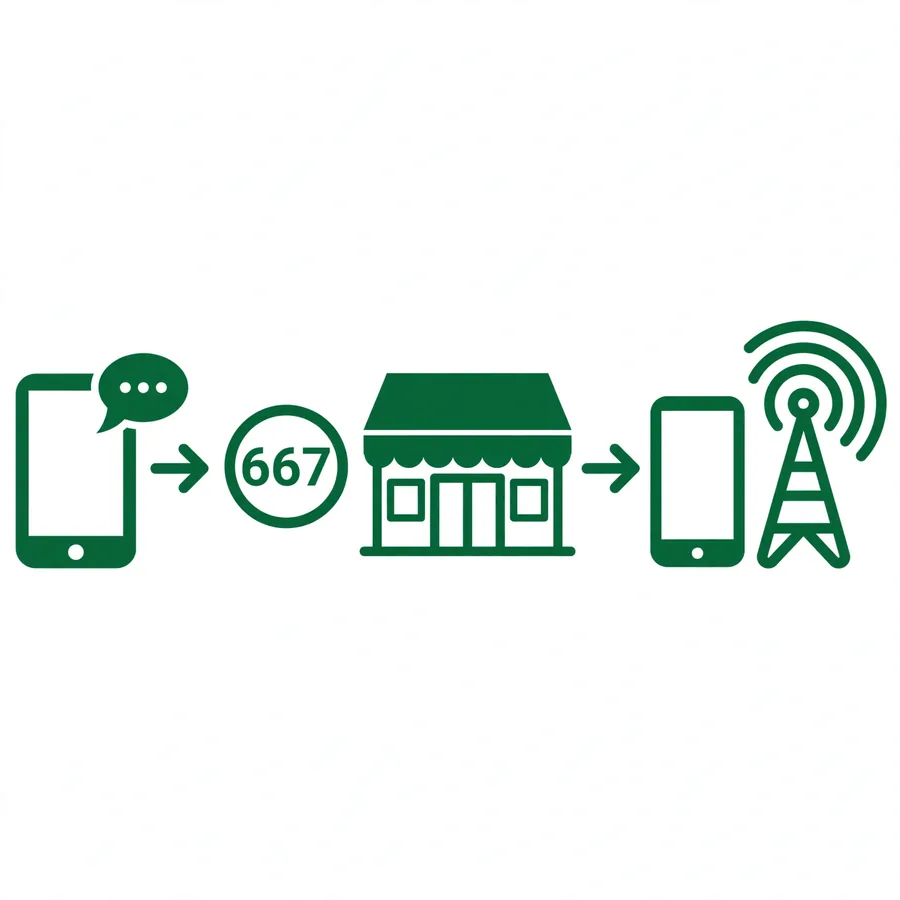
The format is one word. Send MNP to 667 from the SIM you want to check. Uppercase or lowercase both work (MNP, mnp), but add nothing else: no CNIC, no spaces, no extra characters.
- Insert the SIM you want to verify. 667 answers only the SIM that texts it. On a dual-SIM phone, the sending SIM slot decides which SIM gets checked, so pick the right sender in your SMS settings.
- Open your SMS app and type MNP. Exactly those three letters.
- Send it to 667. Do not call 667: it is an SMS-only service, and calling it does nothing at all.
- Read the reply. It usually arrives within 5 to 10 seconds.

What the 667 Reply Actually Shows
The reply reads back the sending SIM’s own registration record. Across the detailed guides, a 667 reply typically shows the registered owner’s name, a partially masked CNIC (never the full number), the mobile number itself, and the SIM’s activation date (competitor-reported; PTA has not published the reply format verbatim).
One honest note: a minority of sources (notably simsownersdetails.pk) report that the reply shows a partial CNIC and network name but not your name, and argue that some sites wrongly describe 667 as an owner-name lookup. The majority of guides report the name is included. Either way, the masked CNIC and activation details are enough to answer the real question: does this SIM’s registration match you?
What 667 Cannot Do
- Check any number you type in. There is no box to enter a number. 667 only ever reads the SIM in your hand. Any website promising a lookup of someone else’s number is selling leaked data, not a PTA service.
- Show the full CNIC, an address, or other SIMs. The CNIC stays masked, and 667 knows nothing about your other SIMs. For the full CNIC audit, use 668 or the portal.
- Work from a different phone. Borrowing a friend’s handset checks your friend’s SIM, not yours.
- Be called. 667 is SMS-only. Dialing it does nothing.
How Much Does the 667 SMS Cost?
Guides converge on typically Rs 1.50 to 2.50, charged at your standard SMS rate. PTA has not published a fixed 667 fee, so treat any “completely free” claim with the same suspicion as the 668 version. Keep a little credit on the SIM: with no balance, the SMS never leaves your phone.
667 vs 668: Which One Do You Need?
| 667 (MNP) | 668 (CNIC SMS) | |
|---|---|---|
| Question it answers | Is THIS SIM registered to me? | How many SIMs are on my CNIC? |
| What you send | The word MNP | Your 13-digit CNIC |
| Scope | The sending SIM only | Every SIM on the CNIC |
| Reply shows | Registration record of that SIM | Count per operator |
| Cost | About Rs 1.50 to 2.50 | About Rs 2 + tax |
| Best for | Used SIMs, found SIMs, porting | Monthly CNIC audits |
The raabty rule of thumb says it best: use 668 every month to audit your CNIC; use 667 whenever a SIM changes hands. Buying a used phone, finding a SIM card, or confirming a SIM you just bought is really yours: those are 667 moments.
Planning to Switch Networks? 667 Is Step 1 of Porting
667 exists because of Mobile Number Portability. Under PTA’s MNP Regulations 2005 and Porting Process Guidelines, texting MNP to 667 is step 1 of moving your number to another network while keeping it. Pakistan launched MNP on 23 March 2007, the first country in South Asia to do so.
- The 667 reply works for 10 days. After texting MNP to 667, visit the new network’s franchise with your original CNIC within 10 days. Miss the window and the old network can reject the port under code R09A (“667 Message Service Not Used”).
- Your number must be at least 60 days old on its current network before it can move (the clock restarts after a port-in or ownership change).
- The port itself takes about 4 days. Franchise short codes for port requests: 76300 (Jazz), 76313 (Zong), 76333 (Ufone), 76345 (Telenor).
- Only want the info reply? Then stop after the reply. Sending MNP to 667 alone does not port anything; the franchise visit is what moves your number.
No Reply from 667? Quick Fixes
- Check your balance. The SMS costs a standard rate; no credit, no send.
- Check your signal. 667 needs a live connection to your network. Test an ordinary SMS first.
- Confirm the sending SIM. On dual-SIM phones the reply describes the SIM that sent the text. If you checked the wrong slot, resend from the right one.
- Resend clean. Type MNP with no spaces or extra characters and send again.
- Still nothing? Wait a few minutes for congestion to clear, then retry. If the SIM was never registered in your name, visit the operator’s franchise with your CNIC for biometric re-verification.
FAQs
What does the 667 reply actually show?
Typically the registered owner’s name, a partially masked CNIC, the mobile number, and the activation date. One source (simsownersdetails.pk) reports the reply shows a partial CNIC and network name without the name; the majority of guides include the name. The full CNIC is never shown.
Can I check the owner of any mobile number with 667?
No. 667 answers only the SIM that texts it. There is no way to enter another number. Sites promising lookups of other people’s numbers are using leaked databases, which is illegal under PECA 2016 Section 16.
Is sending MNP to 667 free?
Not quite. It is charged at your standard SMS rate, typically Rs 1.50 to 2.50. PTA has published no fixed fee for 667.
What exactly should I type: “MNP” or my CNIC?
Only the word MNP, with no extra characters. Your CNIC goes to 668 (or the cnic.sims.pk portal), never to 667.
Does 667 work on all networks?
Yes. 667 works identically on Jazz, Zong, Telenor, Ufone, SCOM, and ONIC, because it is a PTA service built into the national MNP system.
Can I use 667 from outside Pakistan?
Only with an active Pakistani SIM (roaming works, since the SMS must leave the SIM itself). There is no web version of 667; for CNIC-wide checks from abroad, use the cnic.sims.pk portal.
I didn’t get a 667 reply. What should I check?
Balance first, then signal (test an ordinary SMS), then the sending SIM slot on dual-SIM phones. Resend MNP cleanly with no extra characters, and wait a few minutes if the network is congested.
667 vs 668: which one should I use?
Use 667 to verify the one SIM in your hand (used SIMs, found SIMs, porting). Use 668 to audit every SIM on your CNIC. Different questions, different tools.
Does sending MNP to 667 start porting my number?
It is step 1 of the official port-out process, and the reply stays valid for 10 days. But nothing ports until you visit the new network’s franchise with your original CNIC. If you only wanted the info reply, simply do not take the franchise step.
Can I call 667 instead of sending an SMS?
No. 667 is SMS-only. Calling it does nothing at all; you must send the text MNP.
Conclusion
A 667 sim check answers the one question 668 and the portal cannot: is the SIM actually in your phone registered to you? Text MNP to 667, read the reply, and use it every time a SIM changes hands.
Found a SIM that is not in your name? Our SIM Disown guide covers removing it. For the full CNIC picture, see the 668 SIM Check guide and our complete SIM owner details guide.