How to Check SIM Owner Legally [2026 Guide]
The honest answer to how to check sim owner legally is short: your own record, yes; a stranger’s record, no. Every lawful check is keyed to an identity you hold and stops at a hard boundary. Here is the full map. This post is general legal information, not legal advice.
Quick answer: how to check sim owner legally
- You may check: SIM counts on your own CNIC (668 or the free portal).
- Your own SIM: 667 from the SIM itself, 76367 for its network.
- More exists only through legal process: police (section 54), courts, heirs with documents.
- A stranger’s name or location: no legal route exists for a citizen.
Your Legal Toolkit: Five Checks
| Check | What it lawfully shows |
|---|---|
| 668 SMS | An operator-wise count of SIMs on your own CNIC (charges may apply) |
| Portal cnic.sims.pk | The same count, free, CNIC and Foreign ID tabs, works from abroad |
| 667 SMS | The record of the SIM sending it, CNIC masked (whether the name shows is disputed between guides) |
| 76367 | The current network of a number, never an identity |
| Operator counter | Your actual numbers on that one operator, with original CNIC and your biometric, in practice |
Every citizen tool stops at your own record. The counter route is reported practice, one operator at a time, not a quoted PTA entitlement. In-app CNIC-wide lists are unverified and not claimed here. Full steps sit on the CNIC SIM check page.

Who Can Lawfully See More
Police and the NCCIA obtain a subscriber record through legal process under section 54 of the Telecom Act 1996. Traffic data is narrower: a provider produces it only on a court warrant under PECA section 32 (sections 33 and 34: content, search). Courts order records in litigation; section 45 adds victim compensation.
A victim’s route is the section 16(2) application (secured, blocked or destroyed); the statute is clear, the receiving body in practice after 2025 is unverified, so the working routes are the NCCIA and PTA complaints. Heirs act inside the 60-day transfer window of SRO 1519(I)/2026, relatives only, with the death certificate, FRC, valid CNIC, the SIM or an FIR, a recharge check and a signed NOC. An employer audits only its own corporate connections via the operator’s business channel (reported), never an employee’s personal number.

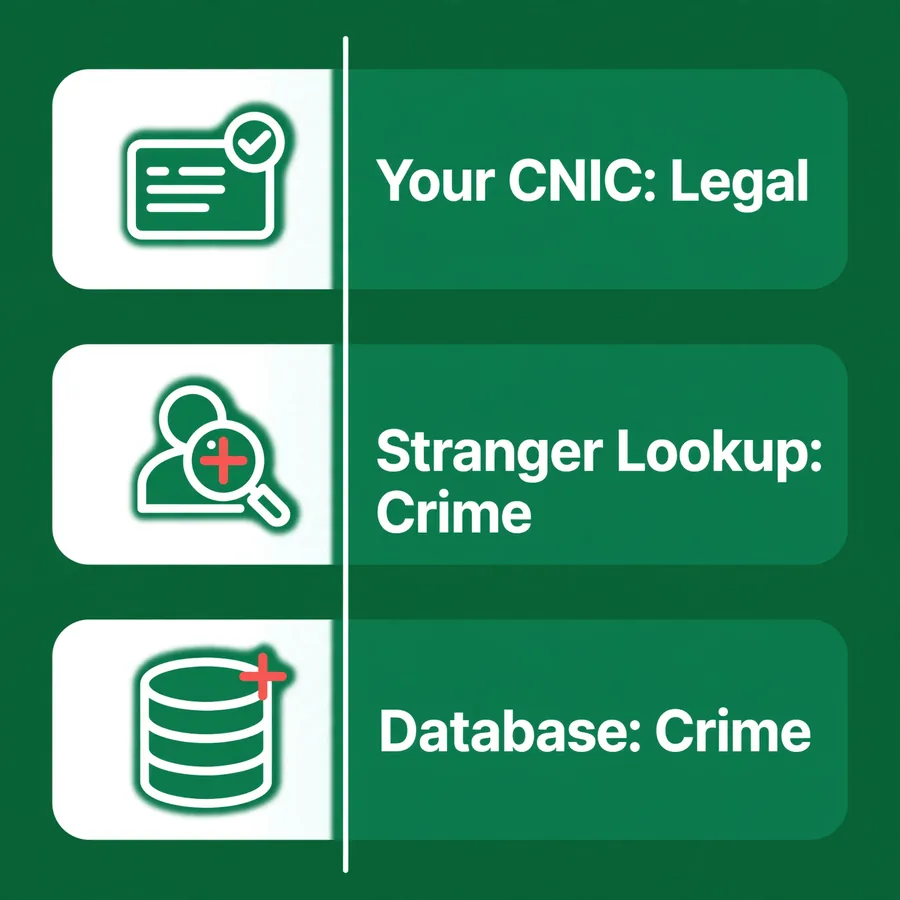
The Line: Legal vs Illegal
| Action | Position |
|---|---|
| Counting SIMs on your own CNIC | Legal: it is the system’s purpose |
| Seeing your own numbers at an operator counter | Legal: with your CNIC and biometric |
| Asking a shop or agent to look up a stranger | Illegal: PECA section 16 |
| Buying a SIM database or lookup service | Illegal: section 16 for buyer and seller |
| An officer obtaining a record | Legal only through section 54 process |
| An heir transferring a deceased relative’s SIM | Legal: documents within the 60-day window |
The line is consent and process, not technology. The sellers are covered in our illegal SIM sites post.
Your Rights Over Your Own Record
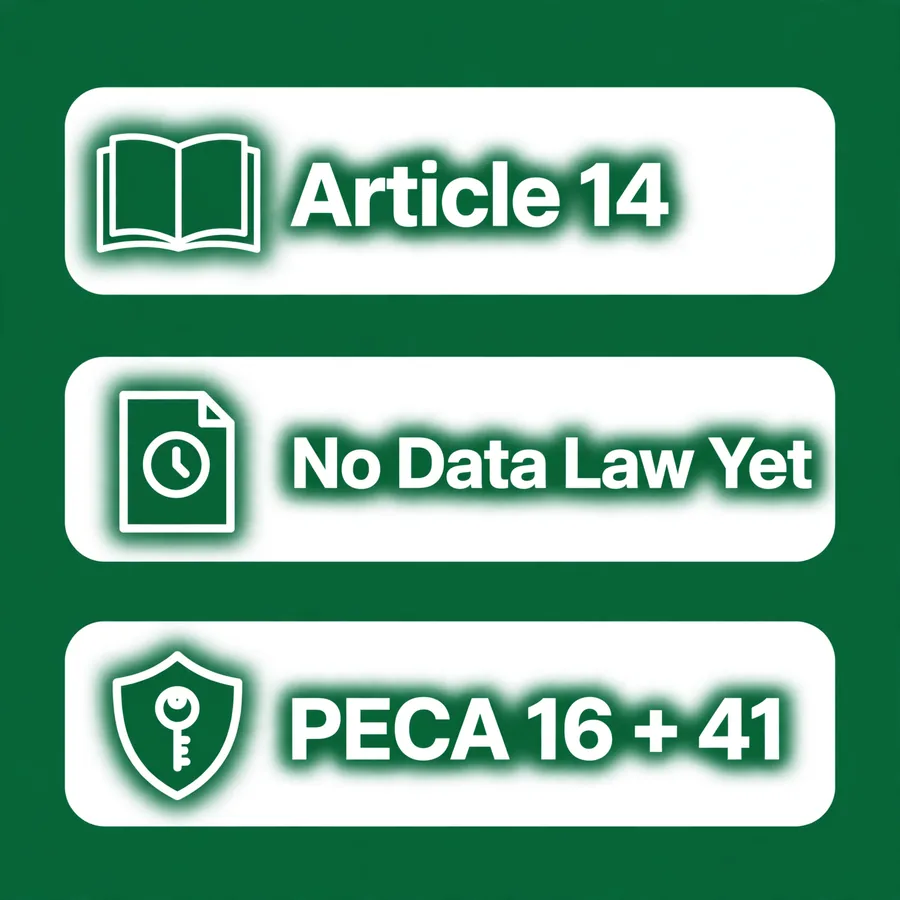
The foundation is Article 14(1): “The dignity of man and, subject to law, the privacy of home, shall be inviolable.” The honest status: Pakistan has no enacted standalone data protection law. The Personal Data Protection Bill 2023 was approved by the Federal Cabinet but has not passed Parliament; its planned commission does not exist in law today.
What protects you today: PECA section 16 (unauthorised use of identity information), section 41 against an insider leak, and the Telecom Consumers Protection Regulations 2009 complaint right over illegal use of personal data. Corrections in one line: disown what is not yours, then a PTA complaint if it will not correct. This section is general legal information, not legal advice.
Family and Work: The Awkward Cases
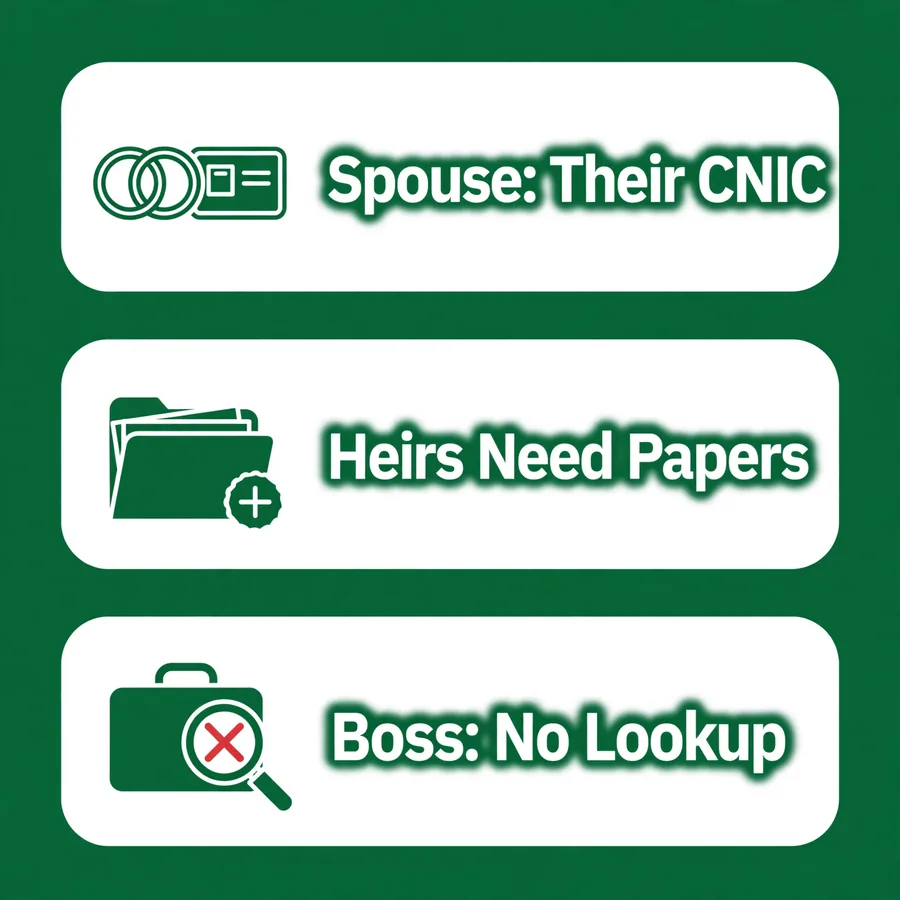
A spouse first: the law names no spousal route and is silent on family checks, stated plainly. The only lawful door is the CNIC holder running their own check or attending their own counter; a partner’s permission does not make a seller’s lookup legal. A deceased parent is the heir route above: documents inside the 60-day window, before blocking by default.
An employer: company connections on the company NTN, yes, via the operator’s business channel; an employee’s personal number, no lookup exists. Children: in practice a child’s SIM sits on a parent’s CNIC and shows in the parent’s own count (PTA, May 2024). An under-18 own-name route is reported, single source; the claimed B-Form guardian mechanism is unverified.
The FAQs below are also general legal information, not legal advice.
FAQs
Can I legally check who owns a number that is calling me?
Not yourself. Report it: NCCIA on 1799, police, or PTA on 0800-55055. The record is obtained under section 54 for the case, not handed to you.
How to check all SIMs registered on my CNIC in Pakistan?
CNIC to 668 (charges may apply) or the free cnic.sims.pk portal: an operator-wise count only.
Can I check a SIM owner’s name by mobile number in Pakistan?
No citizen tool does this; 76367 gives a network only, not an identity.
Is it legal to check someone else’s SIM details?
No: PECA section 16, up to 3 years and/or Rs 5,000,000.
Who can legally access another person’s SIM owner details?
Investigators via section 54 process, courts by order, heirs inside the transfer window. No spouse, employer, landlord or private individual qualifies.
Can mobile network apps show my own SIM registration details?
Reported: your own logged-in SIM’s account only. No CNIC-wide, cross-operator app list is verified.
What should I do if an unknown SIM is registered against my CNIC?
Counter visit with your original CNIC: block, disown, then a PTA complaint if uncorrected.
Can a business register more SIMs than the standard 8-SIM limit?
Reported: yes, registered organisations under SAV Regulation 6, on the company NTN, outside the personal cap.
What happened to SIMs on deceased persons’ CNICs?
A 60-day transfer window under SRO 1519(I)/2026; then blocking by default. 3.2 million blocked in July 2024 to June 2025.
Number se SIM owner ka naam kaise maloom karein?
Legally nahi ho sakta. Apna count 668 ya portal se; kisi aur ka naam sirf legal process se.
Conclusion
The map is the message: counts on your own CNIC, a masked record for the SIM in your hand, a network name for any number, everything else behind legal process. A page promising more for a fee sells the offence in the PECA guide, not a service.